VeYou
Premium short-form drama app
Context
Tommy Harper, a Hollywood producer, came to us with a clear ambition: build a micro-drama app that could actually work for US and European audiences. The category was exploding, but every existing app was built for Asian markets — visually dense, aggressively monetized, and filled with patterns that feel foreign to Western users.
He wanted something different. Premium, not pushy. Clear, not cluttered.
The problem with existing apps
We did a thorough audit of the leading micro-drama apps. The patterns we found were consistent — and consistently alienating for a Western audience:
Aggressive, casino-style monetization borrowed from apps like Temu or AliExpress. Hidden costs, bait-and-switch subscription flows, cluttered interfaces overloaded with prompts to spend.
There was also a structural UX gap: series pages, players, and navigation all felt borrowed from a different era of mobile design. Nothing felt intentional. We also looked at the other end of the spectrum — Netflix, Apple TV — to understand what makes a streaming experience feel trustworthy and premium.
The brief became: take what works in Asian micro-drama (addictive short-form content, strong engagement loops) and combine it with the clarity and craft of Western streaming services.
Scope
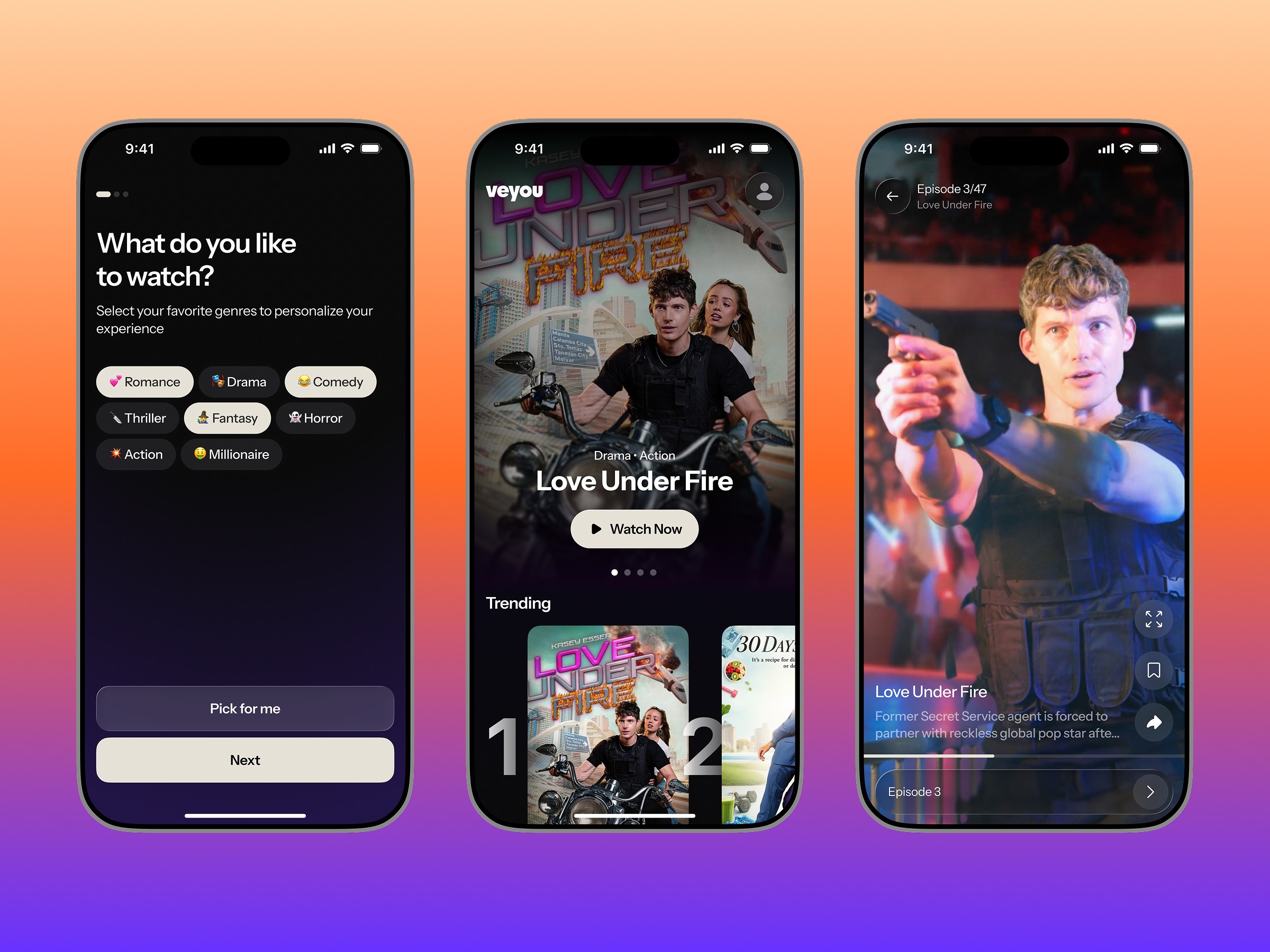
We designed a full product suite in the initial scope: onboarding with personalization, a home feed, a For You page with trailer browsing, a series cover page, video player, watchlist, profile, rewards system, live comments, and a review system.
The release MVP focuses on the core watch flow — onboarding, home, player, profile, settings, and the paywall for series access. The remaining features are designed and documented, ready for the next phase.
Key design decisions
Liquid Glass UI direction. I proposed adopting Apple's Liquid Glass design language for the iOS app, with a consistent aesthetic counterpart on Android. This wasn't just a visual choice — Liquid Glass introduced genuinely useful UX patterns around layering, depth, and contextual UI that were a natural fit for a video-first experience. The client aligned on it after reviewing alternatives, and it became the foundation for the whole visual system.
Transparent monetization. Where competitor apps obscure costs and nudge users toward purchases with dark patterns, we designed the paywall and subscription flow to communicate clearly and directly. No hidden pricing, no fake urgency, no casino mechanics. The bet is that Western users will respond better to trust than pressure.
Series cover page rethought. Instead of the information-heavy, static pages common in micro-drama apps, we designed around a background trailer playing behind a clean information layer — closer to how Apple TV presents content than how Chinese apps do. Actors, episodes, series details — all accessible without clutter.
Player UX details. A video app lives or dies by its player. We sweated the small stuff — how quickly UI elements fade, how the hero image behaves on scroll, interaction timing, edge cases for different content states. This kind of work is invisible when done well, and broken when it isn't.
Process
Two designers on the project: I led product design end-to-end — UX, UI, design system, and close collaboration with the frontend team. My background in frontend development meant I could bridge the gap between design intent and implementation in a way that saved a lot of back-and-forth. My co-designer focused on research, competitor analysis, and future-feature exploration.
For features beyond the MVP — rewards system, live comments, reviews — we ran a structured design process in parallel: research, exploration, documentation. That work is ready to hand off when the product is ready to grow.
Working on a video app means handling a long tail of edge cases. How fast should player controls disappear? What happens at the end of a series? How does access state affect the UI? Each of these is a small decision, but there are hundreds of them — and they compound.
Status
VeYou launched on iOS and Android on April 7, 2025. User research and testing are planned post-launch to validate the core flows and inform the next development phase.